OWL-SDA: A Multi-Agent System for Generating Synthetic Data to Support Ontology Evaluation
Cite thisCitation
Van de Wynckel, M., & De Roock, E. (2026). OWL-SDA: A Multi-Agent System for Generating Synthetic Data to Support Ontology Evaluation. Posters, Demos, Blue Sky, and Tutorials at SEMANTiCS 2026, 4293. https://ceur-ws.org/Vol-4293/paper44.pdf
@inproceedings{vandewynckel2026owlsda,
	author = {Van de Wynckel, Maxim and De Roock, Emmelien},
	booktitle = {Posters, {Demos}, {Blue} {Sky}, and {Tutorials} at {SEMANTiCS} 2026},
	issn = {1613-0073},
	year = {2026},
	month = {9},
	organization = {CEUR-WS.org},
	title = {OWL-{SDA}: A {Multi}-{Agent} {System} for {Generating} {Synthetic} {Data} to {Support} {Ontology} {Evaluation}},
	url = {https://ceur-ws.org/Vol-4293/paper44.pdf},
	volume = {4293},
}
Authors
Abstract
Ontology engineers often need representative RDF instances to validate and document an ontology, but such data may be unavailable, incomplete, too sensitive to share or simply too much work to create manually. We present OWL-SDA, an open-source toolkit that uses worker, supervisor and reviewer AI agents to generate synthetic RDF data from ontology context and SHACL constraints. The workflow combines shape-level task decomposition, direct manipulation of an in-memory triple store, iterative SHACL repair and a final review stage aimed at catching issues that remain possible even after SHACL conformance. We evaluate OWL-SDA on two contrasting ontologies, one for industrial emissions reporting and one for healthcare records. The results show that richer ontology constraints lead to faster convergence and more informative examples, while sparse ontologies require more supervision and still yield less detailed data. We therefore position the toolkit for ontology engineers to help document their ontology, but also to validate if the ontology alone is sufficiently rich to be understood by non-experts.
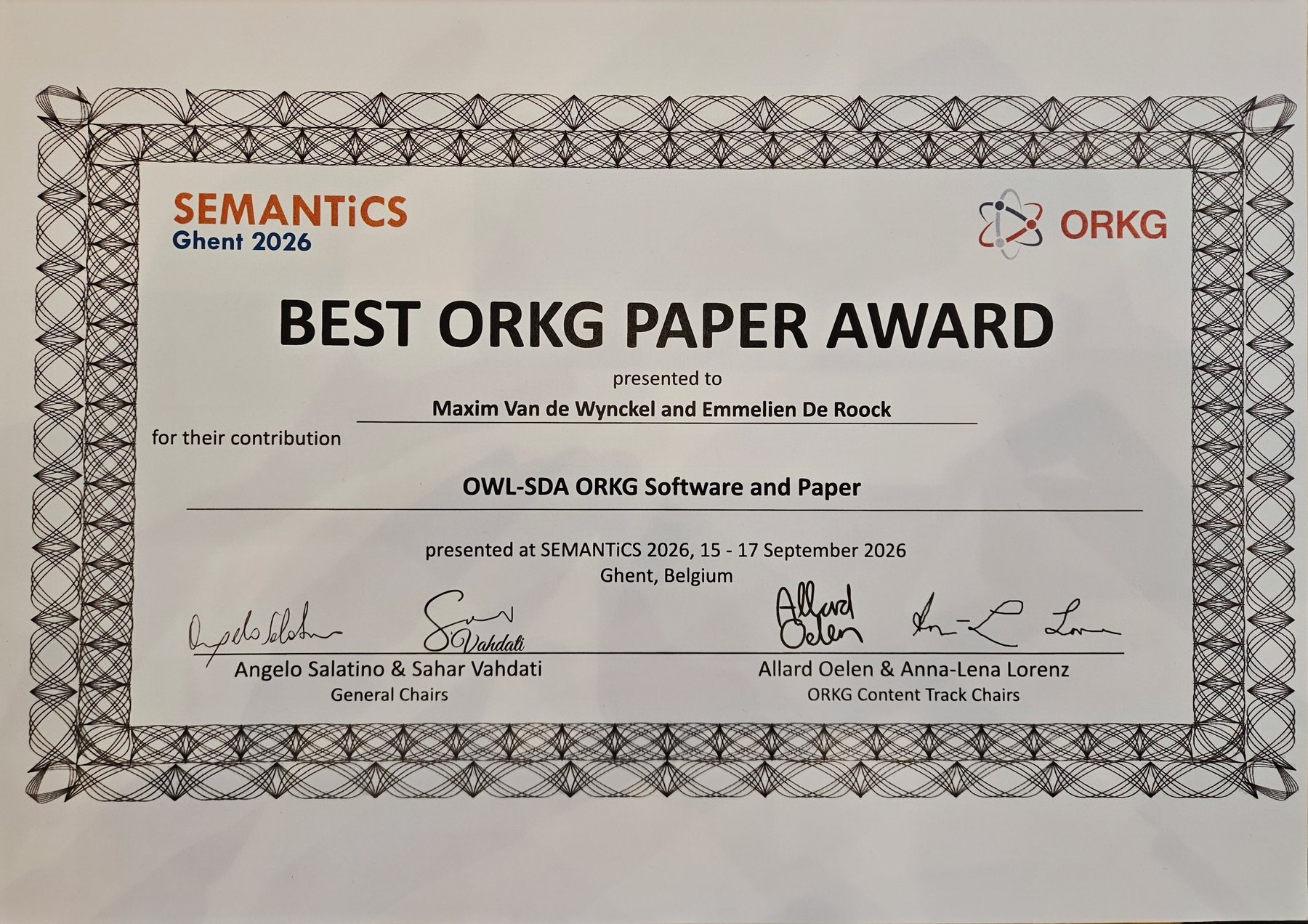
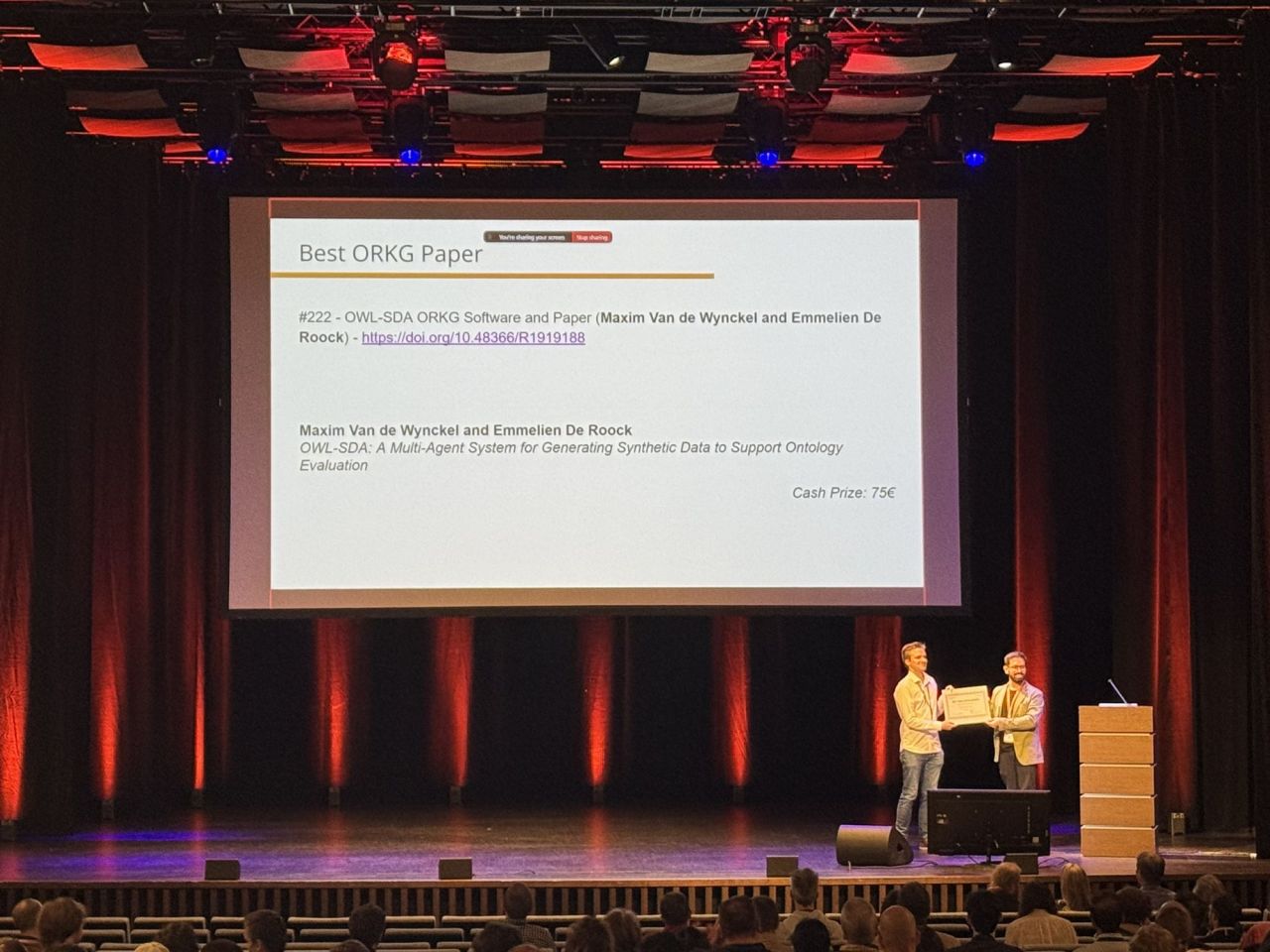
Award
Awarded at SEMANTiCS 2026 in Ghent, Belgium for the OWL-SDA ORKG software and paper.